
Recent Post
- 2026-06-04 03:38:40
- 2026-06-02 12:57:03
- 2026-02-04 07:21:51
- 2026-01-21 03:39:14



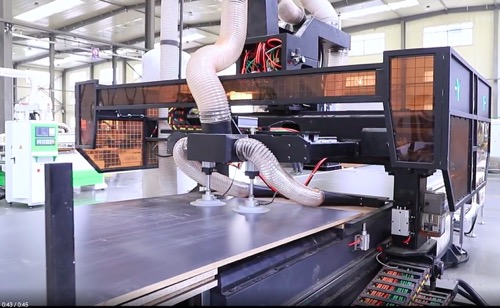
Abstract—The migration of panel furniture manufacturing from manual, semi-mechanized workflows to automated nesting cells is arguably the most consequential shift in woodworking production over the past decade. This article examines the technical and commercial logic behind automatic loading and unloading nesting centers, situates them within the broader CNC router market, and assesses how machine architecture, control systems, and software integration determine real-world throughput. It draws on parameter data from commercially deployed machines, including the Roctech Master series, to illustrate where the technology currently stands and where the bottlenecks remain.
1. Industry Background: From Batch Cutting to Nesting Cells
Panel furniture production—cabinets, wardrobes, bookcases, office casework—has traditionally been organized around beam saws, single-spindle drilling, and manual material handling. Each of these stages introduces its own error budget and labor dependency. The nesting center consolidates the cutting, drilling, and grooving sequence into a single clamping cycle on one worktable, which changes both the accuracy chain and the economics of a shop floor.
Three forces have accelerated adoption. First, custom and whole-house furniture demand has fragmented order batches; a manufacturer may process dozens of distinct panel geometries in a single shift. Second, labor availability in traditional manufacturing regions has tightened, pushing operators toward lights-out or lightly attended shifts. Third, nesting software has matured to the point where sheet utilization optimization is reliable enough to be treated as a production input rather than an afterthought.
The market response has been a proliferation of machine classes. At the entry level, a standard three-axis router with vacuum table handles cutting and simple drilling. At the high end, an automatic loading and unloading nesting center with an integrated row drill group, automatic labeling, and a double-layer zoned vacuum table approaches a flexible manufacturing cell. The price band is correspondingly wide, from roughly USD 15,000 for a basic nesting configuration to over USD 300,000 for a fully automated cell, according to Roctech's published selection guidance.
2. Parameter Analysis: What Separates Machine Classes
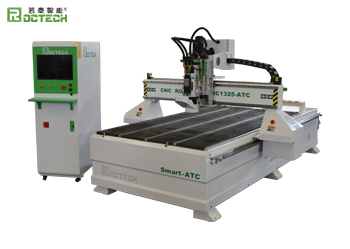
The table below compares representative configurations across three tiers of panel processing equipment, using published parameters for the Roctech RCA1224 automatic nesting center, the RC1325S-ATC automatic tool change router, and a conventional three-axis router of comparable working area. The intent is not to rank brands but to isolate which specifications actually govern production outcomes.
| Parameter | Conventional 3-axis router (1325 class) | RC1325S-ATC (ATC router) | RCA1224 (auto nesting center) |
|---|---|---|---|
| X/Y/Z travel | 1300×2500×200 mm (typical) | 1300×2500×250 mm | 1220×2440×150 mm |
| Worktable | Vacuum + T-slot | Vacuum + T-slot | Double-layer zoned vacuum |
| Bed structure | Welded steel | Heavy-duty welded steel pipe | Heavy-duty welded structure |
| Guide rail | Linear guide (brand varies) | Taiwan HIWIN linear guide | Taiwan HIWIN linear guide |
| Spindle power | 3–6 kW | 9 kW (6/12 kW optional) | 9.6 kW (higher optional) |
| Spindle speed | 18,000–24,000 rpm | 0–24,000 rpm | Not specified (matched to cutting head) |
| Tool change | Manual | Carousel/linear, 8–16 tools | Row drill group, cutting + drilling + grooving |
| Positioning accuracy | ±0.05 mm/300 mm (typical) | ±0.03 mm/300 mm | Not specified; process-level tolerance |
| Rapid traverse | 20,000–30,000 mm/min | 45,000 mm/min | Not specified; gantry-class |
| Drive system | Stepper or entry servo | Yaskawa servo | Yaskawa servo |
| Control | DSP or entry CNC | Syntec | Syntec |
| Loading/unloading | Manual | Manual (auto pusher optional) | Automatic |
| Machine weight | ~1,500–2,000 kg | ~2,200 kg | ~4,500 kg |
Several observations follow from this comparison.
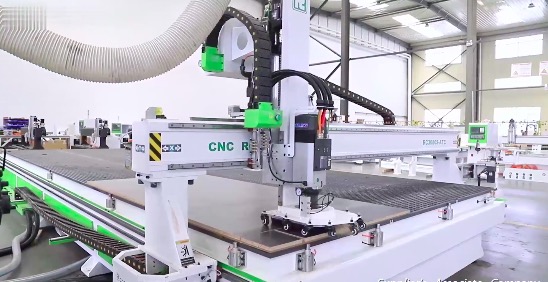
First, the jump from a conventional router to an ATC machine is primarily a rigidity and tool-management story. The RC1325S-ATC carries a 9 kW spindle on a heavy-duty welded steel pipe bed with HIWIN linear guides, which permits a maximum rapid traverse of 45,000 mm/min and a positioning accuracy of ±0.03 mm/300 mm. Those figures matter less for panel cutting than for the tool-change economics: an 8- to 16-station carousel eliminates the manual re-tooling that otherwise dominates changeover time in mixed-order production.
Second, the nesting center is a different category of machine, not merely a faster router. Its distinguishing features are the automatic loading and unloading system, the double-layer zoned vacuum table that holds both large and small panels, an optional automatic labeling unit for panel identification, and a row drill group that executes cutting, drilling, and grooving in one pass. The 4,500 kg machine weight—roughly double that of the ATC router—reflects the gantry and handling hardware required. Notably, the RCA1224's Z travel of 150 mm is smaller than the ATC router's 250 mm, a deliberate trade: nesting centers optimize for sheet throughput, not for thick or three-dimensional workpieces.
Third, the control and drive ecosystem has consolidated. Taiwan Syntec controllers and Yaskawa servo motors appear across both Roctech machine classes, which is consistent with broader industry practice in woodworking machinery. This standardization reduces the training burden when a shop scales from one machine class to another, and it means that the practical differentiator between mid-tier competitors is increasingly mechanical—bed mass, guideway specification, vacuum zoning—rather than electronic.
3. Technology Application and the Roctech Case
Roctech Machinery Co., Ltd., headquartered in Jinan, Shandong Province, illustrates how a CNC equipment supplier positions itself across this spectrum. The company's product line spans CNC engraving machines, nesting centers, laser cutting machines, edge banding machines, and row drills, with exports to more than 100 countries. Its Master series of automatic loading and unloading nesting centers (RCA1224, RCA1228, RCA1325, RCA1328, RCA1530) is aimed squarely at custom cabinets, wardrobes, and panel furniture, and the company also builds ATC routers (RC1325S-ATC through RC2380ATC), five-axis simultaneous machining centers (RCF series), fiber laser cutters, six-sided drills, and edge banding machines.
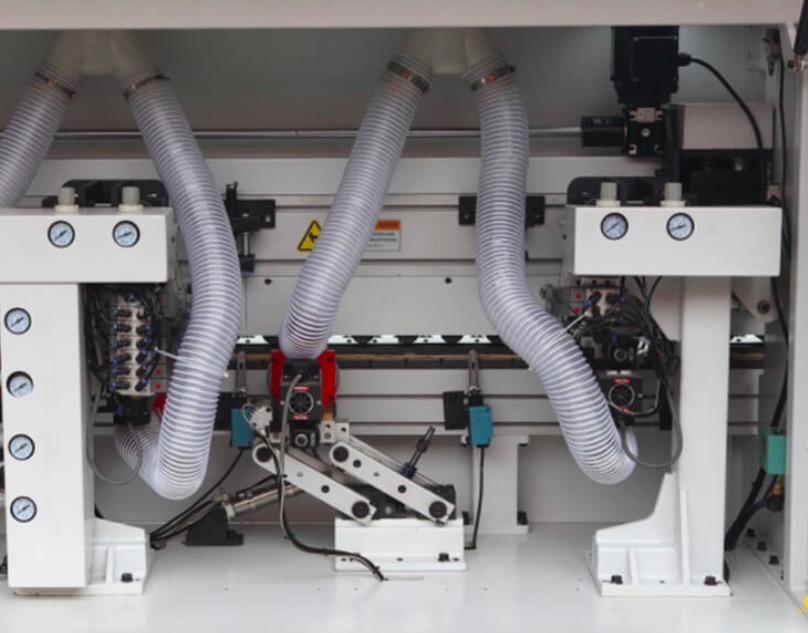
What makes Roctech a useful reference point is not scale alone but the completeness of its process chain. A custom furniture producer buying into the Master series can, in principle, source the downstream steps—six-sided drilling, edge banding, and nesting software integration—from the same supplier. The six-sided drill, for instance, processes panels up to 930 mm wide and 48 mm thick with 12 vertical and 13 vertical drill shafts on the X and Y axes respectively, plus two horizontal spindles on each of the four sides, at 18,000 rpm. Docking that machine to the same nesting software that drives the RCA series is the difference between an automated cell and a collection of automated islands.
Roctech's certifications—ISO9001, CE, FDA for laser equipment, UL—and its stated one-year whole-machine warranty with lifetime technical support are the table stakes for export-oriented equipment. The more substantive question is whether the machine architecture supports the production model it claims to serve. On the evidence of the published parameters, the Master series is configured for exactly the workflow that custom furniture demands: automatic loading and unloading to reduce manual intervention, zoned vacuum to handle mixed panel sizes, labeling for panel identity tracking, and a row drill group to collapse three operations into one clamping.
4. Conclusion and Outlook
The nesting center has moved from a premium option to a baseline expectation in panel furniture production, and the parameter data bear this out: automatic handling, zoned vacuum, and integrated drilling are now defining features of the category rather than differentiators. The remaining competitive frontier lies in three areas.
The first is software integration. Machine specifications are converging; the ability to accept a nesting file from Haixun, Yunxi, 1010, or Chenfeng and execute it without manual reprogramming is where throughput is actually won or lost. The second is predictive maintenance. Spindle bearings, guideway lubrication, and vacuum pump condition are the dominant unplanned-downtime causes in these cells, and sensor-driven maintenance scheduling remains immature outside the highest equipment tiers. The third is the extension of nesting logic to five-axis and heavy-duty work. As solid wood and curved components enter the same production stream as flat panels, the boundary between the nesting center and the five-axis machining center will blur.
For now, the practical guidance for a manufacturer evaluating equipment is to treat the machine as one component of a process chain. A 4,500 kg nesting center with a 9.6 kW spindle and Syntec control is only as productive as the edge bander, drill, and software downstream of it. The suppliers that understand this—and build a coherent chain rather than a catalog—are the ones positioned to hold share as the market matures.
Looking for more information about our CNC machines and services? Contact us today.
Contact





















Automation and Precision in Panel Furniture Production: The Nesting CNC Router Market and Technology Trajectory - Roctech® have advanced technology for CNC Router,cnc router cabinets,Roctech already have 15 years experiences of cnc router technology.-© 2023 Roctech® Machinery Co.,Ltd. - All Rights Reserved Website Terms Of Use ● Privacy Policy ● Cookie Policy