Recent Post
- 2026-10-21 00:31:02



Abstract. Five-axis simultaneous machining has moved out of the aerospace tool room and into the commercial shop floor. Falling prices for rotary heads, more accessible five-axis CNC systems, and a mature supplier base in Shandong have pushed five-axis capability into mold shops, custom furniture plants, and stone fabricators that would not have considered it a decade ago. This article examines the technical and commercial drivers behind that shift, reviews comparative machine data, and considers how mid-tier builders such as Roctech are positioning five-axis platforms against established high-end suppliers.
Industry Background
The economics of five-axis machining rest on a simple trade: capital cost and programming complexity in exchange for fewer setups, fewer fixtures, and access to surfaces that three-axis machines cannot reach without re-clamping. For mold work, the value is obvious — undercut regions on bumper and instrument-panel molds can be cut in a single clamping, and the polishing labor that follows is reduced because the tool maintains a more favorable lead angle to the surface. For solid-wood furniture, five-axis interpolation allows chair backs, curved legs, and sculptural components to be machined without the multiple orientation fixtures that three-axis production requires.
Three developments have accelerated adoption. First, the five-axis head itself has become a commodity item; imported swing heads with ±110° A-axis travel and continuous 360° C-axis rotation are now available to mid-tier builders at price points that were unthinkable fifteen years ago. Second, CNC system vendors — OSAI, Fagor, Heidenhain — have refined their five-axis kinematics and post-processor ecosystems, so that CAM software such as PowerMILL and UG can generate reliable toolpaths without in-house math departments. Third, the buyer base has broadened: custom furniture, architectural millwork, and stone countertop fabrication now demand complex geometry at volumes that justify five-axis investment.
The table below compares representative five-axis configurations across the market tiers, using published parameters for a standard 1300 × 2500 mm platform as the reference point.
| Parameter | Entry-Level Five-Axis | Mid-Tier (e.g., Roctech RCF1325) | High-End Production |
|---|---|---|---|
| Worktable size | 1300 × 2500 mm | 1300 × 2500 mm | 1600 × 3000 mm+ |
| Spindle power | 6–9 kW | 10 kW (higher optional) | 12–24 kW |
| Spindle speed | 18,000 rpm | 0–24,000 rpm | 24,000 rpm |
| A-axis swing | ±90° | ±110° (or ±120°) | ±120° |
| C-axis rotation | 360° indexing | 360° continuous | 360° continuous, direct drive |
| Positioning accuracy | ±0.10 mm | ±0.05 mm | ±0.01 mm |
| Repeatability | ±0.05 mm | ±0.03 mm | ±0.005 mm |
| Rapid traverse | 20 m/min | 30 m/min | 60 m/min |
| Control system | Basic five-axis package | OSAI / Fagor | Heidenhain TNC 640 |
| Machine weight | 4,000–5,000 kg | ~8,500 kg | 12,000 kg+ |
| Typical application | Signage, simple molds | Furniture, molds, foam | Aerospace, automotive tooling |
The data tell a clear story about where the market's center of gravity sits. The mid-tier column — represented here by the Roctech RCF1325 — captures the majority of new five-axis installations in woodworking and general mold work. Its ±0.05 mm positioning accuracy and ±0.03 mm repeatability are roughly an order of magnitude tighter than what three-axis woodworking routers typically hold, yet the machine remains priced for a shop that is not cutting aerospace tooling. Note also the weight differential: at roughly 8,500 kg, the mid-tier machine carries about twice the mass of an entry-level platform, which matters because five-axis accuracy depends heavily on structural damping. A light frame will hold static geometry but will not hold tolerance when the head swings through a compound cut.
The high-end column is a different business. Direct-drive C-axes, 60 m/min rapids, and Heidenhain-class controls push machine cost into a bracket where the buyer is typically a tier-one automotive tooling supplier or an aerospace subcontractor. For most furniture and architectural shops, the marginal accuracy is unusable — the workpiece material itself, whether MDF, solid oak, or granite, will not hold ±0.01 mm over a 2.5 m span.
Technology Application and Brand Case Study
Roctech Machinery Co., Ltd., headquartered in Jinan, Shandong, illustrates how a mid-tier builder assembles a credible five-axis platform from a global supply chain. The company's RCF series — spanning the RCF1325, RCF1838, RCF2040, and RCF2560 — pairs an imported five-axis head with an Italian OSAI control as standard, with German Heidenhain and Spanish Fagor systems available as alternatives. The bed is an integral casting or welded heavy-duty structure, and the machine uses imported guideways and screws to hold its stated ±0.05 mm positioning accuracy. This is not a builder attempting to compete with Heidenhain-equipped German machines on precision; it is a builder competing on the practical definition of five-axis capability for the furniture, mold, and foam sectors.
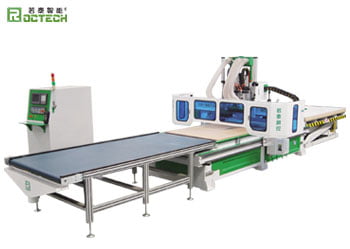
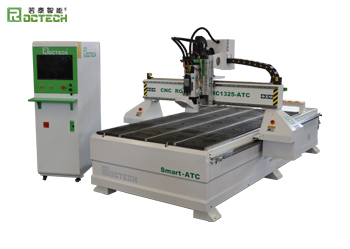
That positioning is reinforced by the breadth of Roctech's catalog. The same company produces automatic loading and unloading nesting centers for panel furniture, ATC engraving machines with 8–24 tool carousels, six-sided drilling centers, edge banding machines, and fiber laser cutters. A shop that buys an RCF1325 for curved solid-wood components can source its nesting, drilling, and edge banding equipment from the same supplier, which simplifies service and spares logistics — a meaningful consideration for export customers in the more than 100 countries the company serves. The company holds ISO9001, CE, FDA, and UL certifications, which are the baseline credentials for entering European and North American markets.
The RCF1325's specification sheet is instructive about design priorities. A-axis travel of ±110° (or ±120° optional) is generous for woodworking but standard for mold work; the 10 kW spindle is modest by high-end standards but adequate for the depth of cut that solid wood and aluminum mold stock permit; and the 15 m/min maximum feed rate is deliberately conservative, favoring contour accuracy over raw speed. These are the choices of a builder optimizing for the furniture and general mold trades rather than for high-speed metal cutting.
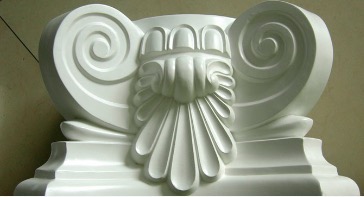
Stone fabrication deserves separate mention. Five-axis interpolation is increasingly used for sculptural stonework, curved countertop edges, and architectural cladding with compound geometry. Stone imposes its own constraints — abrasive dust, coolant management, and tool wear rates that dwarf woodworking — and machine builders must specify sealed guideways and appropriate dust extraction. The five-axis platform is adaptable to these conditions, but the buyer should verify that the specific configuration has been engineered for stone rather than wood.
Conclusion and Outlook
Five-axis machining has completed its transition from specialty capability to standard offering in the mid-market. The technical enablers — commodity rotary heads, mature CAM post-processors, accessible CNC systems — are in place, and the supplier base in China has demonstrated that it can assemble these components into machines that hold commercially useful tolerances at prices that make sense for furniture and mold shops. The competitive frontier has therefore shifted from "can the machine interpolate five axes" to "can the supplier deliver the kinematic accuracy, the post-processor support, and the service network that keep a five-axis machine productive over a ten-year life."
For buyers, the practical guidance is to match the machine tier to the material and tolerance regime, not to the specification sheet's most impressive number. A shop cutting curved oak chair components does not need ±0.01 mm; it needs rigidity, reliable tool change, and a control system its programmers can actually use. Builders such as Roctech that occupy the mid-tier with credible imported components and broad product-line integration are well positioned for the next phase of adoption, in which five-axis becomes the default for complex geometry rather than the exception.
Looking for more information about our CNC machines and services? Contact us today.
Contact
Previous:Precision at the Edge: How CNC Stone Carving Automation Is Reshaping Modern Fabrication
Next:Not






















The Industrialization of Multi-Axis CNC: Five-Axis Machining Centers in Mold, Woodworking, and Stone Fabrication - Roctech® have advanced technology for CNC Router,cnc router cabinets,Roctech already have 15 years experiences of cnc router technology.-© 2023 Roctech® Machinery Co.,Ltd. - All Rights Reserved Website Terms Of Use ● Privacy Policy ● Cookie Policy